Company: Public Consulting Group
Client: 28+ Exceptional Children departments, including scopes at the local and state level.
Background:
When it comes to building a SaaS platform, a clean interface is not enough. Stability and a well designed UI will sell your product and wow your customers, but what you do behind the scenes will transform the way they think about their work.
Herein lies how you make a platform competitor resistant. A client can weather the change in an interface. They will learn quickly. You will not be special enough to always fend off other options. What your clients will struggle to let go of is a thought partner who knows them, their history, and their priorities.
It is from this observation that I began developing an approach to reporting literacy.
Scope:
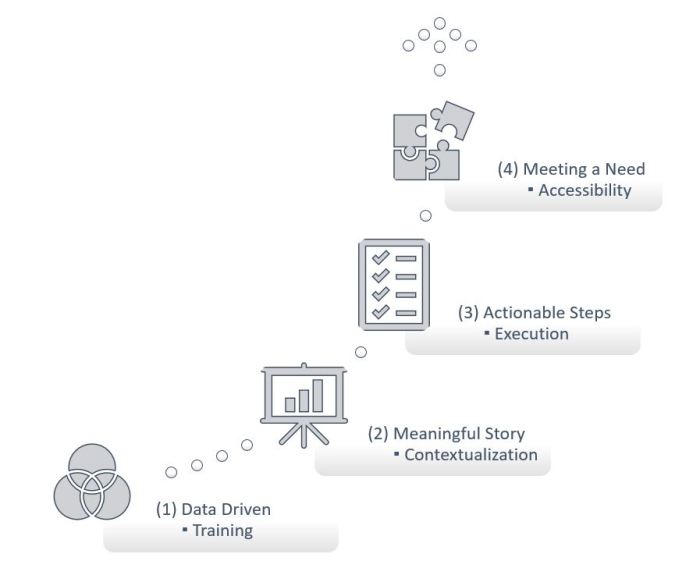
The goals for this initiative developed somewhat organically, but the single defining principle was this: We need to (1) use data to (2) tell a meaningful story (3) that provided actionable steps for (4) improving a client’s ability to support student needs. The challenge is that the skills, resources, and concerns varied widely across our client base. So how do you develop a sustainable support model that can be used across all clients, regardless of size or need, without falling into the trap of over complicating processes?
Approach:
Data Driven: Training is the obvious place to start. Data driven decision making is a buzz phrase. The problem with buzz phrases is that recognition can easily be confused for understanding. Staff had to be trained on how to use data, how to draw conclusions from data, and understand how knowing what you don’t know can impact your narrative. We had to de-buzzify “data driven decision making” so that we could see information for what it is, and begin building a story. For this, I delivered:
- Internal training, both individual and group.
- External training curriculum. In total, over 30 hours of recorded video.
- Strategic district intervention, specifically for the purposes of developing self-sustaining capacity.
Meaningful Story: Data, on its own, is meaningless. You must be able to orient it to a place, a group, and a moment in time. A change in identification rates could be the result of a new director, a change in reimbursement policies, a new assessment released to the field, the influx of migrant families following seasonal crops, or other factors that may not be housed in your data set. To be successful, we must be transparent about our methods, our data, and our assumptions. Clients will be excited about what is possible. They will not be excited about having to explain a stretched assertion during a status meeting.
Actionable Steps: Data is meaningless if you cannot do anything with it. We supported a regular meeting of all clients to discuss data, reporting tools available, and current events that can impact their district. Clients working with us on reporting initiatives became part of an in-group, with access to both PCG expertise and a medium to connect with their peers. It is here that districts could ask the question of “How are you handling…” to a unique set of people who understand their subject and their need.
Meeting a Need: It is easy to conflate meeting a need with actionable steps. The distinction I’m making here is that the needs we’re addressing are protracted over a period of time. In other words, a need is more than simply an answer. To meet a need, data must be readily available, flexible enough to build upon, and function as a benchmark for growth. I developed an approach to designing concise reports supported by a longitudinal dataset that can be revised as new nuance is identified.
Keys to success:
The results of this initiative have made a substantial impact on PCG’s North Carolina clients. My work has been used to address needs such as staffing allocation, gap analysis, compliance monitoring, disproportionality, grant applications, and federal reporting, among other needs. Continued success builds upon the foundation of applying data to tell a meaningful story, where actionable steps can be taken to meet a need, but then applies these additional considerations:
- Identify dependent variables, and begin capturing in your set when practicable.
- Listen first. Don’t create problems that your data can answer, use the data you have to solve the problems that exist.
- Make data discoverable. Simplify access to information and target common areas of need.
- Develop a checklist for any inquiry. The formula will breed consistent rigor.
- Develop a curriculum that satisfies the spectrum of proficiency for your clients, so they can grow on their own time.
- Be consistent in helping them meet a need. Data driven results work best when used as gentle pressure applied relentlessly.
- Understand what your minimum level of acceptable rigor is, and then scale up based upon the client’s need.
Want to talk about reporting? I’d love to hear from you.
 David Whitcher